Technique is what we would call the basics and include passing, receiving, dribbling, finishing, defending etc. and young players are usually coached these in the North American system. However, often they are not taught the other more subtle capabilities and the why these capabilities are so important . These are critical to the speed of development and gives them a much greater understanding of the game.
A key component of our methodology is the regular use of small-sided games. These formats are widely used across top academies because they significantly increase player involvement and accelerate learning.
Research comparing 4v4 to 8v8 formats has shown substantial increases in key actions:
These increases are not marginal. They are transformational. More touches, more decisions, and more moments under pressure create a richer learning environment, ultimately leading to greater development over time.
When players are taught new skills they need to make conscious decisions to develop those skills. To be a top footballer these need to be become unconscious decisions as the higher standard you play the less time you have. Small sided games are essential in speeding this process of conscious to unconscious decision making.
We are all aware as our children get older their capacity to learn and retain information increases. At the same time they mature and become physically stronger the physical work load can increase. Football is no different. This is why UEFA clearly define stages of development by age.
Promotes basic motor skills in an enjoyable, multi-sport environment.
Develops foundational sport-specific skills and overall movement coordination.
Focuses on establishing an aerobic base, developing speed and strength, and consolidating basic sport-specific tactics.
Emphasizes physical conditioning, sport specialization, and learning to manage competition pressure.
Maximizes performance, conditioning, and recovery for elite, high-performance competition.
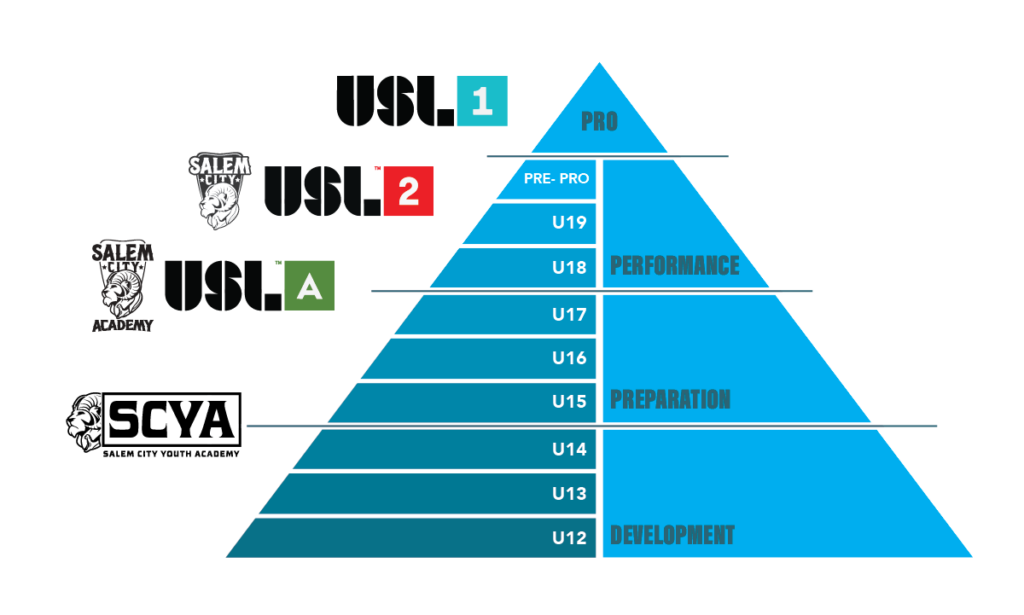
The primary focus is always on speed of development. Competition is required and the joy of scoring a goal and winning is an important element of the game but it can be detrimental to the development of players, particularly at an early age. If they are to develop the 6 core competencies they must be given the time and opportunity to learn and practice, and sometimes this is at the cost of winning. In European academies many of the players don’t play in league systems until they are 13 years old and even then the emphasis is on the speed of development not winning. Often this is counter intuitive to what we have been taught but it is proven to work and produces the finest footballers.
At The Salem City Academy We use these core building blocks when our UEFA qualified coaches design each practice session in The Salem City Academy. Sessions are designed by UEFA qualified coaches and all of our coaches are taught to coach using these.
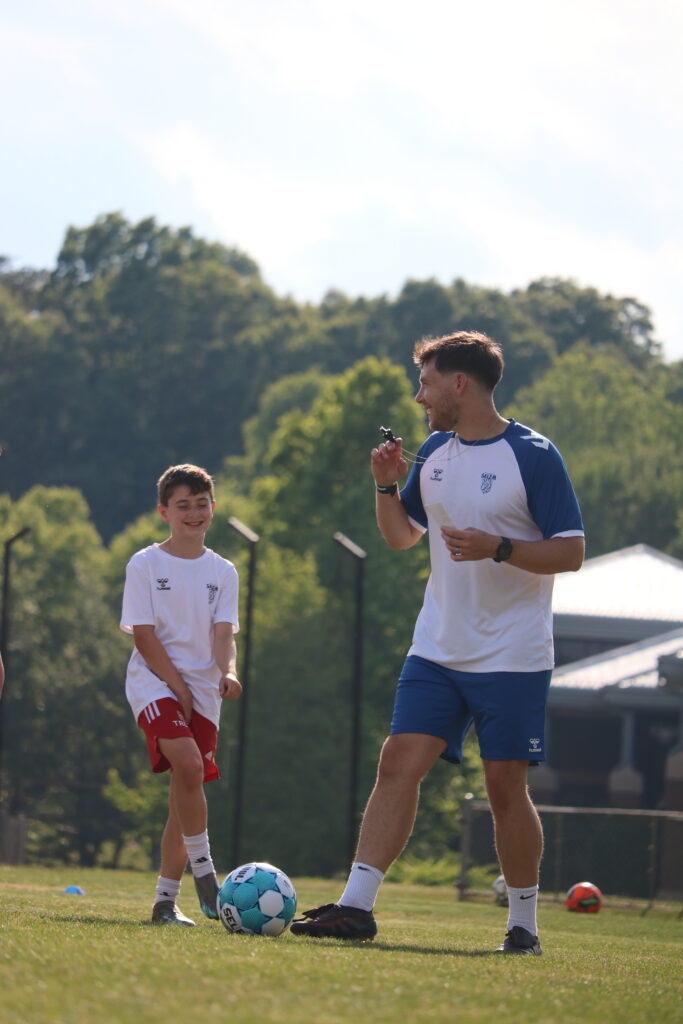
Development cannot be achieved without the right standards and does not occur in comfortable environments. It requires a setting where players are consistently challenged and held accountable but this environment must also be fun, positive and supportive.
This includes standards in how players prepare, train and how they respond to both success and adversity. These daily habits form the foundation of long-term improvement.
Led by UEFA-qualified coaches with international experience. Our coaches know the UEFA methodology have implemented it at elite levels across Europe and the United States, bringing a standard of instruction that simply isn’t available in many locations in North America. What they’ve seen and coached at the highest levels, they bring directly to your player.
Every session is designed with purpose. Every player is coached with intention. Nothing in our program happens by accident. Each session has a clear objective tied to the UEFA methodology and individual and team development plans. Every coaching intervention is deliberate and the player’s time on the pitch means something.
Repetition alone is not enough. Repeating incorrect habits only reinforces them. True development lies in the detail: body shape, first touch, timing, and decision making. These small elements, consistently refined, become the difference at higher levels of the game. For this reason, every session at Salem City is designed with clear intent. Each activity has a purpose, and every action connects to a broader objective. Players are not only instructed on what to do, but guided to understand why it matters. This understanding accelerates learning and supports long-term development. Modern skill acquisition research reinforces that development is not linear. Players improve through varied, game-like experiences that challenge them to adapt, make decisions, and solve problems. As such, our environment is designed to reflect the demands of the game, rather than relying on isolated or repetitive drills alone.
We use the UEFA designed Individual Development Plan (IDP) to set goals, monitor progress and clearly communicate with players and parents. Parents are partners in development, not passengers. We communicate openly throughout the program so families always know where their player stands, what’s improving, and what needs work. We build an initial plan at the start of the program and then have formal updates 4 times per year to monitor progress including an end of year summary. These highlight achievements, strengths and weaknesses and make specific recommendations for continued growth. This gives you real insight, not an opinion, into where your child stands and what comes next.
While the structure and quality of training are critical, the amount of meaningful time a player spends within that environment is equally important. Across many programs, training sessions typically last between 60 and 75 minutes. At Salem City, sessions run for 90 minutes, a deliberate decision based on the belief that players deserve more opportunity to develop within a high-quality environment.
An additional 15 minutes per session may seem minimal in isolation. However, over the course of a season, the impact becomes significant:
When combined with a training model built around high-involvement practices such as small-sided games, those additional minutes translate into:
Over time, these small differences become meaningful advantages. Development is not simply about participation. It is about the volume of high-quality, relevant experiences a player accumulates.